
News
MyCare: Putting Survivors’ Needs at the Centre of Digital Survivorship Support
21/09/2026
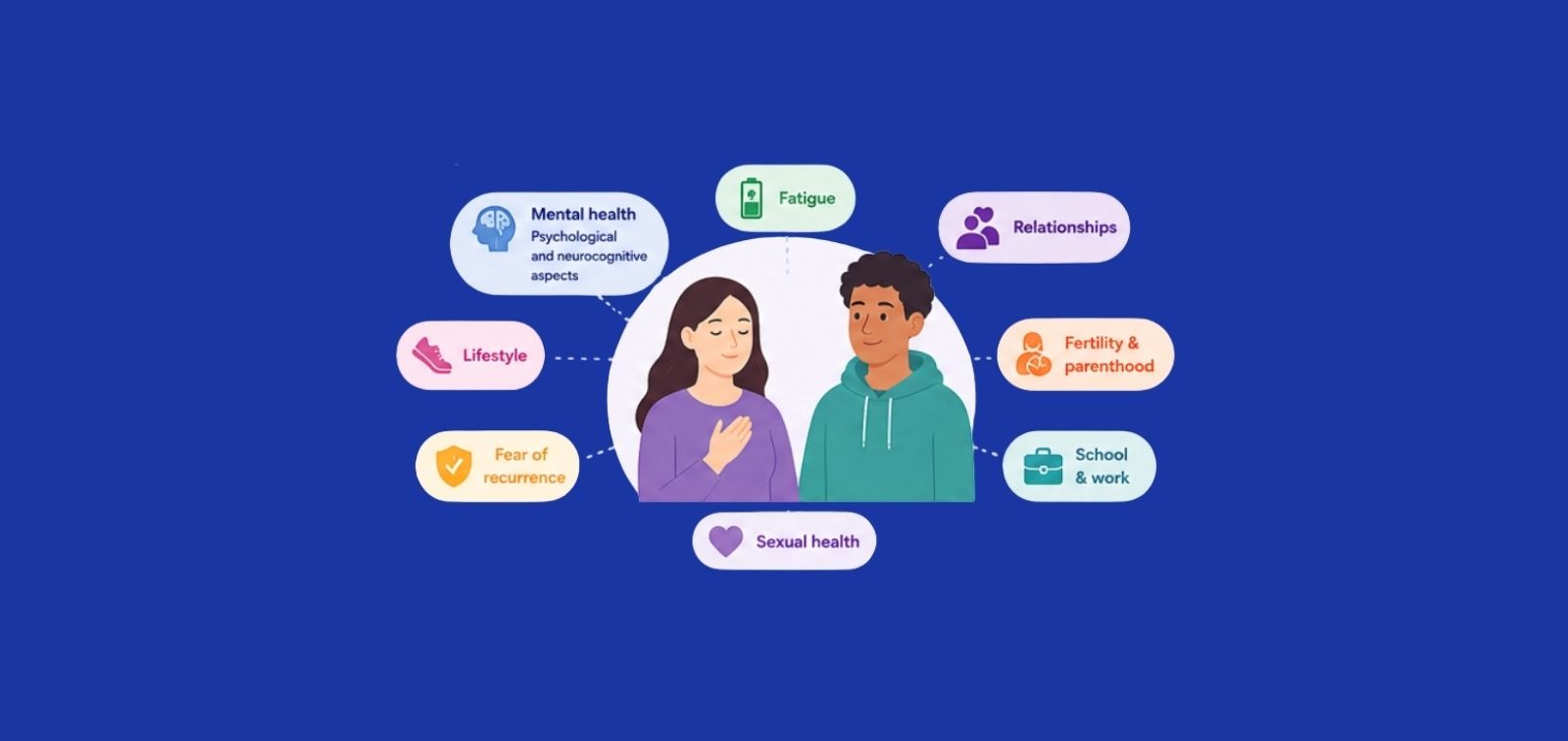
A new e-QuoL tool co-designed with survivors to provide personalised information, support and self-management resources
Cancer survivorship is about much more than medical surveillance. After treatment, childhood, adolescent and young adult cancer survivors may have questions about fatigue, mental health, relationships, fertility, education, work, lifestyle or how to manage the consequences of cancer in everyday life. Long-term consequences can extend across physical, psychological and social dimensions. The challenge is therefore not simply to provide more information. It is to help each survivor find information that is relevant to them, at the moment when they need it. This idea is at the heart of MyCare, a new digital environment developed within e-QuoL.
Starting with a different question
Risk-based clinical tools such as the “passports” after cancer like LOG-after, SurPass… start from medical characteristics to determine which surveillance recommendations apply to an individual. MyCare complements this approach by starting somewhere else: “What does this survivor need or want help with now?” This distinction shaped the whole development of the tool. MyCare was designed to provide personalised educational and supportive resources while leaving survivors free to explore information independently and decide what matters to them. This approach reflects findings from e-QuoL showing strong interest in personalised, accessible and user-friendly digital survivorship tools.
Designed with survivors, not simply for them
MyCare was developed using e-QuoL’s participatory approach and the FormIT methodology, built around repeated cycles of Explore, Create and Evaluate. Survivors, members of their support networks, healthcare professionals, researchers, patient organisations and digital-health specialists contributed to its development. Workshops and targeted consultations explored needs and expectations. These were translated into design concepts and prototypes, which were reviewed and refined iteratively. The process can be summarised as:
Listen → Design → Test → Refine → Build
But co-design did not stop at asking people what they wanted. A major part of the work was translating statements such as “I want information that is relevant to me” into something a digital system could actually deliver. That meant deciding what information should be collected, how resources should be described, what makes a resource relevant to a particular person and how the system should rank potential recommendations. This participatory philosophy is central to e-QuoL, which uses digital innovation to address both medical and psychosocial gaps in survivorship care.
Tell MyCare what matters to you
One of MyCare’s central features is its Needs Assessment. Survivors can identify areas in which they currently want information or support, such as mental health, fear of recurrence, fatigue, relationships, intimacy and sexual health, fertility and parenthood, school and work, or lifestyle. But MyCare goes one step further. Two survivors may both be concerned about fatigue but want completely different things. One may want to understand what it is. Another may want practical advice on how to manage it. MyCare therefore allows users to express not only the topic they are interested in but also the kind of question they are asking: What is it? How do I talk about it? How do I manage it? This gives personalisation a starting point based on the survivor’s own priorities.
How does MyCare find relevant resources?
Behind the simple interface is a structured, knowledge-based recommendation system. Articles, videos, podcasts and other resources are manually curated and described using structured information. This includes their main theme, the questions they address, key concepts, format, language and the audiences or contexts for which they are particularly relevant. MyCare can then compare this structured description with the needs and preferences expressed by the survivor.The system primarily considers what the survivor says they need, before using contextual information and content preferences to refine the ranking. This is an explicit, human-defined recommendation process rather than a black-box machine-learning system. The logic can therefore be inspected and adjusted by the multidisciplinary team.
Medical history adds another layer — when relevant and consented to
Sometimes a resource is particularly important because of a survivor’s previous cancer or treatment. MyCare can therefore use selected medical information as a separate layer of personalisation, when relevant and when the survivor has consented to its use. The distinction is deliberate. Medical history may be essential when providing information about a treatment-specific late effect. But it should not automatically determine which information someone receives about relationships, anxiety or returning to work. MyCare therefore keeps two questions separate: “What matters to me now?” and “What additional information is relevant because of my medical history?” This prevents medical risk from automatically overriding a survivor’s own priorities.
Recommendations are only one way to explore MyCare
Personalisation should help people find useful information — but it should not decide what they are allowed to see. That is why MyCare also includes a Library, where survivors can independently browse available resources, explore topics, find previously viewed content and save favourites. The Library also contains structured Interventions: sequences of resources designed to guide someone progressively through an activity or topic, such as guided breathing exercises or art-therapy sessions. In this way, MyCare combines recommendation with autonomy.
From information to self-management: My Tools
MyCare also includes a private area called My Tools. Here, survivors can choose aspects of their health or well-being they want to follow over time, set personal goals and write their own notes. Measures may concern areas such as anxiety, quality of life or individual symptoms. These data belong to the survivor-controlled space. They are not directly visible to healthcare professionals and do not automatically change the recommendation algorithm. However, survivors can choose to use what they have recorded to support a conversation with their healthcare team. The aim is to move beyond simply delivering information and give survivors tools to observe, reflect, set goals and act on what matters to them.
Personalisation that changes as life changes
A survivor’s priorities at 18 may be very different from their priorities at 25, 35 or 45. MyCare therefore does not place users into permanent categories. The Needs Assessment can be repeated, preferences can change, and recommendations can evolve as new needs or circumstances emerge. This reflects a central idea behind e-QuoL: survivorship care should adapt to people’s lives rather than expecting people’s lives to fit a fixed model of survivorship care. MyCare brings this principle into a digital environment by combining personalised support, independent exploration and survivor-controlled self-management. Ultimately, its ambition is simple: not to tell survivors what they should care about, but to help them find the right support for what matters to them now. Personalisation in MyCare is not only about what support is provided, but also about making that support accessible in the survivor’s own context. MyCare currently brings together 172 resources, providing survivors with a broad range of information and support tailored to their needs and interests. The platform is available in eight languages — English, French, Italian, Spanish, German, Hungarian, Norwegian and Slovenian — and its content, i.e. the ressources, is being translated into additional languages, including Dutch, Danish, Finnish, Ukrainian and Croatian. As new resources are added and translations progress, the MyCare library will continue to grow throughout the e-QuoL project.
If you want to know more, a scientific article has been submitted – as soon it is accepted, the reference will be added here.

 Schweizerische Eidgenossenschaft