
Resources
Stronger than They Realise? Between Resilience, Performance and Vulnerability
16/07/2026
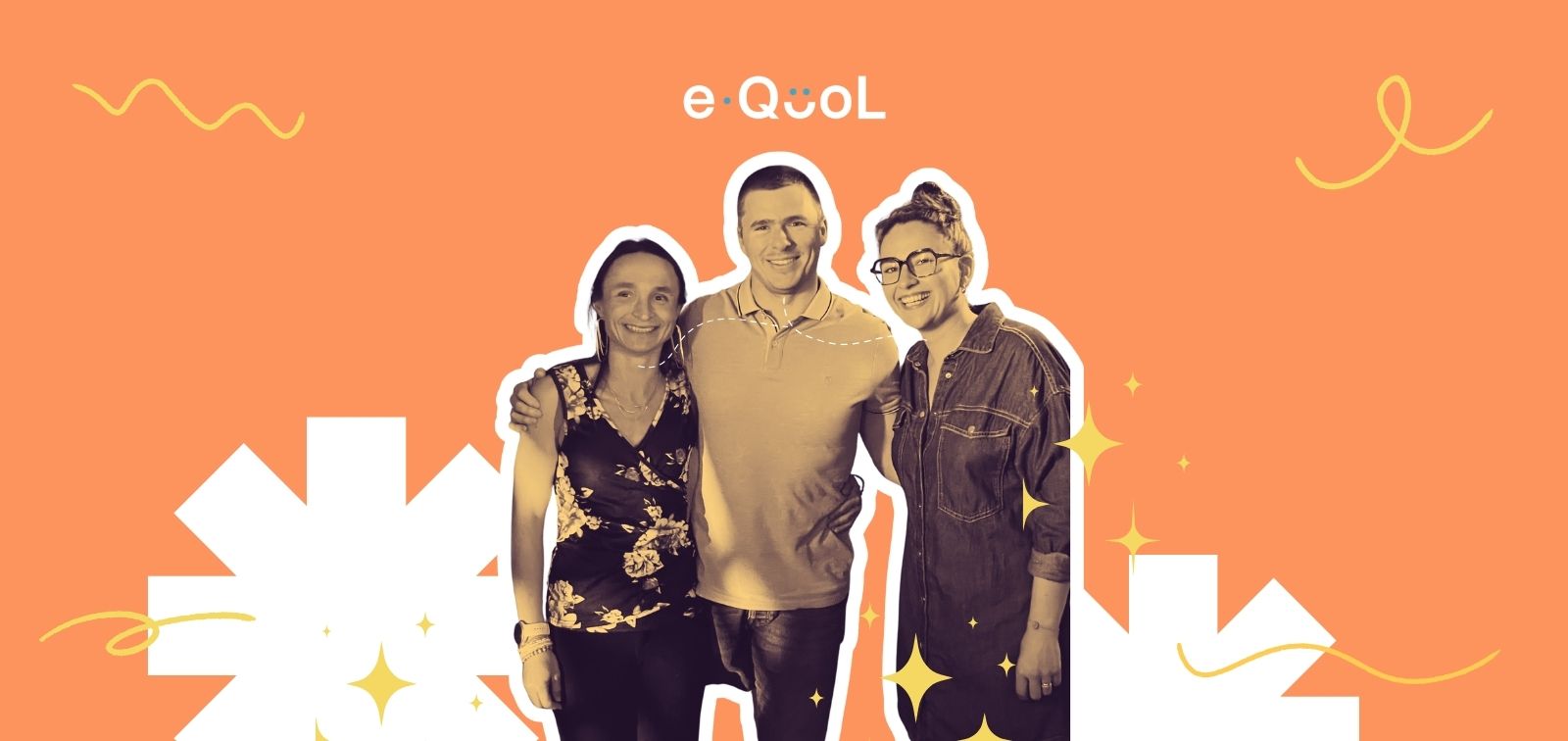
This article is part of the “Healing in Two Voices” series developed within the e-QuoL project, which brings together survivor voices and professional reflections on life after childhood and adolescent cancer. In this series, professional contributions do not aim to add explanations or conclusions. They create spaces for reflection — ethical, psychological, and clinical — opened by the testimonies themselves.
1
My cancer of the femur (Ewing’s sarcoma) was diagnosed in March 1991, when I was not yet five years old. I underwent a series of treatments over 15 months, culminating in my amputation in June 1992, which was the only way to save my life given that it was impossible to stop the disease.
From that whole period, I have only a few images in my mind, mostly in the form of flashes. Hospital scenes, a glimpse of an anaesthetic mask being placed over my face, waking up after my amputation… Looking back on that time is difficult for me, not because it’s too emotionally painful, but simply because I have no memories to draw on…
Is it because I was too young to remember, or a defence mechanism following that terrible ordeal? Probably a bit of both…
I’ve never sought to look back on my medical history, read my medical records, or ask my parents questions about it. I preferred to grow up, move on, and make the most of everything life had to offer.
I began to reflect on my past when I became a patron of the Association Onco Plein Air (AOPA), an organisation that offers activities to young patients receiving treatment in two cities in France (Angers and Nantes). Taking on this role as a patron after the London 2012 Games made me realise that my own journey might perhaps inspire young people, give them hope and encourage them to get active and believe in their dreams.
I can’t say exactly how I realised what was happening to me at the time… The situation was far more difficult for my parents, who realised not only the seriousness of what was happening, but also the high likelihood that I might not survive… I think I understood that something very serious was happening to me, but I don’t think I realised that I might die from it. Especially as death was a rather abstract concept for any child of my age…
It came as a huge shock after the London Games, when a lady found me online on behalf of her nephew, aged about twelve, who was about to have an amputation after going through the same stages as me. When I checked in on him three months later, I learnt that metastases had been discovered in one of his lungs… a few months later, he was gone… It was then that I truly realised what I’d narrowly escaped…
My parents did their best to shield me from that prospect, showering me with love, reassuring me about what was happening to me, and spoiling me with toys. But looking back, I can see just how terribly worried they were all the time. In the end, even though I went through the treatments, the chemo, the operations… I think this ordeal was harder for them to cope with than it was for me.
After the amputation, my memories are still a bit hazy. I gradually learnt to walk with a walking frame, then crutches, and finally a prosthesis. And naturally, I gradually found my bearings so I could get about on one leg – to have the freedom to move around whilst keeping my hands free. My parents’ house has tiled floors. I used to practise hopping from one tile to the next, getting faster and more precise each time. Right from the start, I had this taste for a challenge, this desire to push my limits.
Overall, it’s mainly that feeling of striving to surpass myself that comes back in my memories. On walks, during activities, going a bit faster, a bit further…
Yes, I’ve had moments of anger towards my body, towards the injustice that was thrust upon me. Adolescence was a more complicated time in terms of my relationship with my body and my self-confidence. I don’t think I felt particularly proud of my body’s appearance. But on the other hand, I didn’t try to hide my disability. I wasn’t ashamed of my body. The wheelchair fencing club I was part of helped me a lot with that too.
Sport helped me find my bearings, build up my physical abilities, and wheelchair fencing allowed me to truly flourish, to feel that I could excel and get the better of my disability by proving to myself and to everyone else what I was capable of.
Today, I’m proud of my abilities, of having exceptional balance on one leg, and of being able to go wherever I want with my crutches. I’ve visited many places around the world; I’ve travelled across Thailand with a rucksack; I’ve climbed the Dune of Pyla; I can go out in the snow; near my home, I go for walks in the forest and climb the peaks of Auvergne. My little act of defiance is overtaking half the people walking along the trails.
But for the past few years, I’ve felt that, little by little, my body is tiring more quickly than before, and that I need to listen to it rather than trying to carry on as if nothing were wrong.
I fell in love with fencing straight away. This sport is everything I’d hoped for: strategy, technique, physical commitment, mental strength, safety… and the childlike joy of playing with swords!
At my club in Vannes, which I joined at the age of 8, I was surrounded by a man and a woman from the French national team and the fencing master who had taught them everything. My eyes would light up when they told me about their competitions, when I saw their medals. When I took part in my first competition at the age of 11 – the French Junior Championships, which I won – I realised that I, too, wanted to become a champion.
My elite athlete status helped boost my self-confidence, with recognition for my results and the hard work I’d put in.
That said, I was on the elite list from 2006 onwards. Back then, the profile of para-sport was much lower than it is today, and even though the sporting performances were there, the recognition was far more limited.
I believe I truly became an athlete when I moved up to the senior circuit in 2003. At the age of 16, I took part in my first international competition, a World Cup in Spain. A few months later, having been promoted to a higher age group, I took part in my first French senior championship, competing against members of the French national team whom I was beginning to get to know… and I won it in the foil event! A few weeks later, I took part in my first European Championship, which was held in Paris. My strong individual performance earned me a place in the foil team, and we won the bronze medal. Those first medals, won ‘among the big names’, set my whole career in motion.
Little by little, I earned the status I’ve achieved. Today, I feel recognised as a champion before I’m recognised as a person with a disability. That said, the media coverage of para-sport has gradually brought it into the spotlight, but it’s only very recently that attitudes have really changed.
Up until London 2012, media coverage was still very limited, and performances tended to go largely unnoticed. From Rio 2016 onwards, with increased media coverage, para-athletes were viewed through the lens of resilience, with comments – to generalise – along the lines of ‘well done for what you’re doing after what’s happened to you’. ’ It was only with Paris 2024 that we were finally recognised fully as athletes, with media coverage focusing on our sporting preparation, our goals and our emotions during the Games, without dwelling on our life stories. And that is the common thread among Paralympic athletes: the disability is there, we don’t hide it, but we don’t let it get us down. What matters to us is how to achieve top performances and win medals.
Still, I can’t help but feel that I naturally have a role as an ambassador – for my sport and for para-sport in general – and an image of resilience and strength that I want to convey. As I get about on one leg with my crutches, my disability is obvious at first glance when I’m out on the street. My daily mantra is that people shouldn’t notice my disability, but rather the vigour with which I embrace it. Naturally, this leads me to project an image of strength, even though deep down I sometimes don’t feel I have the resources to do so. I put a bit of pressure on myself to stay strong – for the sake of my image as an athlete, and for what I want to share in my talks as a speaker. But I realise that acknowledging one’s vulnerability isn’t an admission of weakness; on the contrary, it reveals the humanity behind the image we wish to project.
I don’t hesitate to see a healthcare professional when something’s wrong physically, and I’ve learnt to do the same when it comes to my mental health (more recently). I find it harder to tell my loved ones that I’m not well, even when they can tell.
People tend to think that being a Paralympic athlete means I only have to worry about my training and competitions. They don’t realise that I don’t earn a penny from my sport, that I’ve had to hold down a job on the side, or that I’ve had to fight to secure funding for my sporting project. All of this behind-the-scenes work adds an immense physical and emotional strain. As for myself, I try not to dwell on the complications; it’s important to stay positive in order to keep moving forward.
Everyone who doesn’t know me asks if I’m going to compete in the next Paralympic Games in 2028, and they’re disappointed when I tell them no. In all good faith, they often reply, ‘Oh come on, those medals make you want to go and win more”, but they have no idea of the incredibly long journey I’ve already been on to get this far, and they don’t realise that behind my smile and my good health, I actually know that my body nearly gave out before the Paris Games and that it wouldn’t be able to withstand another four-year cycle of intense effort.
As soon as the ‘intensive’ post-cancer medical monitoring ended, confirming complete remission, I put my medical records behind me. I’ve never sought to read them again or find out exactly what happened during that time when I’ve forgotten so much. Sometimes, in conversation, my parents tell me a bit more, but that doesn’t raise any new questions for me.
As an athlete, I underwent the medical check-ups that were required of me, but as far as the cancer itself is concerned, I no longer have any specific follow-up.
The doctors had warned me of two possible long-term consequences of the treatments I’d received: one relating to my heart, and the other to infertility. As for the first, the sports medical check-ups I’ve had over many years haven’t revealed anything abnormal. As for the second, when my partner and I started planning to have a child, we decided to have a test done so we could find out quickly. The verdict was clear-cut: total infertility… It took a two-year course of assisted reproductive technology (ART) involving gamete donation before we were able to have our daughter, who is in perfect health.
Like many people, I think I’d rather avoid having to deal with the medical system. Of course, I’ll see a professional if there’s a need. Fortunately, since my cancer, I haven’t had any serious health problems. But I dread the day when I might have to undergo surgery.
I’d like doctors to understand that treatments undergone in childhood, and disability, have a profound impact on self-confidence and self-image. My teenage years were a difficult time, and I realise that all of this still affects my sense of well-being today.
I also still experience phantom limb issues. Unlike many people, I can no longer feel my leg, but I have regular bouts of pain. The best way I’ve found to describe it is to imagine a fork being stuck into my scar every 20 seconds. A simple paracetamol taken as soon as the first twinges start stops the problem straight away, but if I can’t take it, it can lead to complications lasting several days. And for years, before I found this solution, I had terrible episodes of insomnia, sleeping in a separate room from my partner because I was tossing and turning in pain and biting my pillow to stop myself from screaming.
Since the end of the Paris Games, I’ve retired from top-level sport. These days, I try to listen to my body much more. To achieve my sporting dreams, I stuck to a relentless schedule and situations that created a sense of moving at 100 km/h, never stopping. In a way, I know I love that pace, that intensity. But the accumulation of roles, of things to do, and of the commitment I had to give on every front, left me feeling as though I was constantly suffocating from the age of 15 to 38…
I went through a very difficult period at the end of the Rio Games, when I’d pushed myself to the point of overtraining and exhaustion due to my sporting goals and my role as captain of the French team… and once the post-Games media whirlwind had died down a little… I became a father three weeks later! I think I suffered a sort of burnout during that time…
I did my best throughout the Paris 2024 journey, which spanned six years, to maintain the overall balance as effectively as possible. In fact, I often say that it’s thanks to my focus on this three-way balance (sporting life, professional life, personal life) that I’ve been able to perform at the highest level for so long – for over 20 years. Fortunately, my employer was very accommodating and provided me with the best possible arrangements to balance my sporting and professional careers. But this journey required total commitment. I always say I had six jobs in one:
- Athlete (an average of 15 hours’ training per week)
- Banking adviser (with working hours adjusted depending on the year)
- Father (looking after my daughter when I wasn’t away on business)
- Project coordinator (organising training sessions, responding to enquiries via email and phone calls, completing paperwork, monitoring the budget, expense claims, booking flights and hotels, etc.)
- Social media ‘influencer’ (building my online presence to attract partners)
- Sales representative (reaching out to my network to secure contacts with business leaders, making initial contact, arranging meetings, presenting the project, negotiating partnerships, securing approval, finalising contracts, following up with counterparties, etc.)
The weeks were incredibly intense! I’m delighted to have successfully completed this adventure. But I’m also very happy to finally be able to slow down a little and decide for myself how busy I want my schedule to be in my new role as an entrepreneur.
People didn’t realise just how much work went into it (apart from my close friends and family, of course). And all that work surrounding the project sometimes made me lose sight of the project itself: the sporting performance, without which nothing could come to fruition. Being by nature quite an anxious person, I was always plagued by doubts: will I succeed? Will I find the necessary funding? Will it all go well? Will I be able to cope, physically and mentally?
Then there’s the dizzying emotional low you face when you come out of the Games. I’ve spoken about the aftermath of Rio. I’d needed to take a holiday after London too, but I was more focused on my career at the time. For Paris, with all that experience under my belt, I expected it to happen again; I’d prepared myself for it… Except that I’d never imagined we could experience such a crazy atmosphere, such fervour from the crowd, such enthusiasm far beyond anything I’d ever dreamed of. Like the other French athletes, we were carried so high on a wave of emotion, swept up in that general sense of magic, that I couldn’t escape the harsh comedown – that feeling of emptiness and that nothing made sense anymore… Fortunately, I quickly turned my attention to my new professional project, which helped take my mind off things.
Burnout can also come from saying ‘yes’ too often… I want to fulfil my role as an ambassador for my sport and as an athlete, to convey the messages and project the image of a champion who can inspire many people. But I’m constantly overwhelmed by endless requests for sponsorship, speaking engagements, and appearances at events… all on a voluntary basis, because an athlete is inevitably seen as a nice person who wants to show off their medals… It’s ‘just’ attending a meal; it’s ‘just’ turning up for an hour at an event; it’s ‘just’ coming to speak to some children… I’ve more than enough to keep me busy as a full-time volunteer for several years, but that doesn’t put food on the table. And for every person who approaches me, it seems like no big deal, but the sheer volume of requests is overwhelming my diary and preventing me from devoting enough time to both my career and my family life… So, reluctantly, I’ve had to start being very selective about the requests I accept, and I only take on those that are particularly close to my heart. But once again, this takes up time that I can’t devote to my work or my family (and this testimonial is no exception!😉 )
The need to prove what I’m capable of is something I impose on myself above all else. Where it’s hardest is in top-level sport, when past achievements don’t count – only the performance in the moment matters. Being able to constantly push your limits to win is very challenging, and exhausting in the long run, but I know why I did it.
Even today, I still tend to want to prove to myself that I can do it, that I don’t need any help… but I try to listen to myself, to recognise that accepting a helping hand isn’t an admission of weakness. I feel that, as time goes by, little by little, doing certain things takes a bit more energy, and that my body is finding it harder and harder to cope. I try to recognise these limits and accept them rather than pushing myself too hard.
To the 6-year-old boy I once was, I’d say that he’s going to have lots of extraordinary adventures and become a very famous knight!
To young people who are finding it hard to envisage their future, I’d say above all that it’s important to find what really excites them, what interests them, what they’re passionate about, what they want to do, and what sort of lifestyle they want to lead… the path will gradually become clearer… that’s how I went about my career change! If possible, have a dream, and once you’ve found it, realise that it won’t just happen by magic… It’s going to take time, energy and effort… but achieving that dream – or getting closer to it – is the greatest sense of pride you can feel.
I’ve been asked many times how I think my life would have turned out if I hadn’t lost my leg… I’ve never asked myself that question, because my disability happened when I was so young that I went on to forge my own path – an unconventional one, but a coherent one. I always say that I consider myself luckier in this situation than if I’d had a car accident as an adult, with a break in the course of my life.
I’d say that cancer robbed me of a carefree childhood and an adolescence in which I would surely have flourished more. But it has given me a strength of character and a resilience that have led me to this extraordinary life, which fulfils me completely.
The message I’d like to convey through my journey is that you can feel good about yourself with a disability, and that living out your dreams is far more precious than just dreaming your life away.
When I look at my medals, I see just how far I’ve come to get to this point. The hard work, the sacrifices, the doubts, the difficulties… But also the joys, the people I’ve met, the pleasure of sport, the pride in these achievements, the thrill of victory, the laughter with friends, the journeys I’ve made…
Ludovic Lemoine, Mentor & Speaker, Triple Paralympic Medalist
2
After a childhood cancer, we sometimes meet people whose journeys seem extraordinary. Sports champions, artists, entrepreneurs, volunteers in charities, carers, patient advocates – they sometimes become role models for other patients and for society.
Through their successes, we naturally tend to see their strength, their determination and their ability to overcome obstacles.
Yet this account reminds us of a more nuanced reality.
Resilience does not mean the absence of difficulties.
Nor does it mean that the consequences of cancer have disappeared.
Some after-effects remain with them for life. They may be visible, such as an amputation, or much more subtle: chronic pain, fatigue, infertility, worries about the future, the need to gradually adapt one’s pace of life, or simply the constant effort to continue meeting others’ expectations.
Over time, many survivors also discover another reality: life after cancer is not just about regaining what has been lost or pursuing one’s dreams despite the obstacles.
It often involves a more complex balance between the plans one wishes to realise, the resources one has available, any lasting effects, the changes the body undergoes over the years, and the need to learn to listen to oneself.
This search for balance is not unique to former patients. It is part of the human experience. But for some of you, it may arise earlier, or in a more visible way, due to treatments received during childhood or adolescence.
Finding one’s place between ambition and adaptation, between the desire to move forward and the need to slow down, between achieving and looking after one’s health, is often a learning process that continues throughout life.
This account also illustrates how our perspective on strength evolves over the course of a lifetime.
As a child, he had to learn to walk all over again.
As a teenager, he had to find his place amongst others.
As an adult, he had to achieve his sporting dreams.
Today, a new challenge has emerged: learning to listen to one’s body and accepting that certain limits exist.
In our societies, we often hold those who push beyond their limits in high regard.
But sometimes there is another kind of courage: recognising when you’re tired, asking for help, slowing down when necessary, and accepting that vulnerability is also part of the human experience.
As a long-term care doctor, I meet former patients who are all very different from one another.
Some talk of a struggle. Others prefer never to use that word.
Some find their balance through sport, their family or their work. Others follow completely different paths.
But many share the same experience: that of learning, over the years, to build a life that is not defined solely by cancer, whilst taking into account the legacy it has left behind.
This account reminds us that it is possible to live life to the full with a disability, to fulfil one’s dreams, to travel, to become a parent, and to succeed professionally and in sport.
It also reminds us that no amount of success can fully shield us from fatigue, doubt or vulnerability.
And perhaps true strength lies not only in carrying on.
Perhaps it also lies in learning to listen to one’s body and, when necessary, accepting the need to slow down.
Dr Charlotte Demoor-Goldschmidt, Survivorship Medical Doctor expert – Radiation oncologist CHU Angers, CHU Caen, Inserm U1018, France
3
Reading Ludovic’s story, I am struck by the strength that runs through so many of your journeys. That ability to keep going, to pick yourself up, to pursue your dreams despite the obstacles. But I am also moved by what he shows us more subtly: the burden that comes with having to be strong.
Following a serious illness, a disability or a difficult life journey, we often receive messages celebrating courage, resilience and pushing oneself beyond one’s limits. These qualities are important. They sometimes enable us to carry on when the path seems impossible.
But they can also become a source of pressure.
By constantly being the one who pulls through, who inspires others, who carries on no matter what, it can become difficult to acknowledge one’s tiredness, doubts or limitations. It’s as though being vulnerable might undo everything that has been achieved.
Yet mental health isn’t built on a constant pursuit of performance. It’s built on a more subtle balance between our resources and our limits.
Doing your best is a valuable thing. But doing your best doesn’t always mean doing more. It can also mean slowing down when you’re exhausted, accepting that a day might be less productive, recognising that you need help, or that you don’t have the energy to carry everything on your own.
We live in a society that often values those who push their limits. Yet learning to respect one’s limits is sometimes just as courageous.
I really like the idea that perfection is the enemy of self-confidence. When we strive for perfection, we risk feeling as though we’re constantly failing. Conversely, when we get to know ourselves better – recognising not only our strengths but also our vulnerabilities – we develop a more stable and deeper sense of self-confidence.
This confidence doesn’t come from being exceptional. It comes from being able to face ourselves with honesty and kindness.
Accepting one’s limitations does not mean giving up on one’s ambitions. It remains important to pursue one’s dreams, to make progress, to make an effort and to fight for what matters. But it is just as important to allow oneself to be tired, vulnerable or less effective at times.
Perhaps true strength does not lie solely in our ability to push beyond our limits. Perhaps it also lies in our ability to recognise them and to treat ourselves with sufficient kindness when we encounter them.

 Schweizerische Eidgenossenschaft